Tokenizers: How large language models see the world
This chapter covers
- Creating tokens from sentences
- Controlling vocabulary size with normalization
- Avoiding risks in tokenization
- Tokenization strategies to remove ambiguity
As discussed in chapter 1, in the world of artificial intelligence, it is often helpful to find analogies to human learning to explain how machines “learn.” How you read and understand sentences is a complex process that changes as you get older and involves multiple sequential and concurrent cognitive processes [1]. Large language models (LLMs), however, use simpler processes than human cognitive processes. They employ algorithms based on neural networks to capture the relationships between words in large amounts of data and then use this information about relationships to interpret and generate sentences.
Our discussion of how these algorithms work will begin with their input: sentences of text. In this chapter, we explore how the LLM processes these sentences to become inputs for the model. Just as language is critical for how you think and process information, the inputs to an LLM are crucial in influencing what kinds of concepts and tasks LLMs can perform.
2.1 Tokens as numeric representations
It may seem obvious that LLMs should process sentences, but to fully understand, we must be more specific. As we talk about how LLMs work, you will see that textual sentences are unnatural for the neural network algorithms that power LLMs because neural networks fundamentally employ numbers to do their work. As shown in figure 2.1, the algorithms employed by LLMs must convert human text into a numeric representation before working with it. Tokens are the representations that LLMs use to break text into pieces that can be encoded as numbers.
Figure 2.1 To understand text, LLMs must break text into tokens. Each unique token has a numeric identifier associated with it.
You can think of tokens as the smallest unit of text an LLM processes—an “atom,” if you will, the smallest part from which all other things are built. So what are the atoms of text? Consider this: As you read this book, what are the smallest building blocks that your brain uses to process meaning? Two natural answers are letters and words. It is very tempting to define letters as the atom since words are made of letters, but do you consciously read every letter in every word? For most people, the answer is “no.” (If you are dyslexic like one of the co-authors of this book, this is a bizarre question. But cognitive processing is complex and not fully understood; please bear with us on the analogies!) You look at the more prominent words and word parts. In fact, you can probably understand this sentence even though we didn’t use the right spelling or letters. People unconsciously use parts of words to process text, and LLMs are built using the same principle.
In this chapter, you will learn how the process of converting text to tokens works. First, we will discuss tokens in more detail; then, we will discuss the procedures used to decide how sentences are turned into tokens.
2.2 Language models see only tokens
Feature engineering is the process of converting your data to a form that is more convenient to your algorithm and the task you want to solve. To build an algorithm that can detect the language of a given text, you could write code that takes text as input and outputs the percentage of times each character occurs. For example, if é appears a lot in a document, you have a good feature to indicate that the document is more likely to be Spanish or French than Russian or Chinese. Sound feature engineering is concerned with thinking through how your model works, what you want to achieve, and how to prepare your data for the combination of model and goal.
Tokenization is the feature engineering of LLMs; it is critically essential because tokens are the only information a model interacts with. Tokens are seen as individual, abstract things that are not inherently connected. The relationships are learned through observation of data.
Looking back at figure 2.1, it is evident that the tokens for Dis and dis are related, the only difference being that one starts with a capital D. However, you can see that the model assigns the identifier 4944 to Dis and the identifier 834 to dis. That is, the model doesn’t inherently see any connection between the tokens representing Dis and dis, even if we, as humans, see an obvious connection. The model doesn’t even see Dis or dis. For an LLM to process tokens, we must convert those tokens into numbers so that the model will see the numbers 4944 and 834. Importantly, the model doesn’t have any direct way to know that these tokens are related.
A token is a mapping from a subword to a unique numeric representation. In turn, tokenization is the process of converting a full-text string into a sequence of tokens. If you have used machine learning libraries before (especially any natural language processing [NLP] tools), you are probably familiar with some of the simpler forms of tokenization. For example, a simple tokenization process breaks a text into tokens by splitting a text based on spaces. However, this approach limits our abilities to create subwords or process languages that don’t use whitespace to delimit words, such as Chinese.
2.2.1 The tokenization process
The generic process that tokenization follows is shown in figure 2.2 with four key steps:
- 1 Receiving the text to process—This means obtaining text input as a string data type (a collection of letters, digits, or symbols) from a user, the internet, or whatever source that has the text you want.
- 2 Transforming the string—This often involves changing the string in some useful way, such as converting uppercase characters into lowercase. This could also be done for security reasons (e.g., the text came from a user, and we need to remove anything that might look like some malicious input) or to eliminate irrelevant variations in the text to help the algorithm learn better. This process is known as normalization.
- 3 Breaking the string into tokens—Once a string is available, it needs to be separated into a sequence of discrete substrings; these are the tokens found in the larger string. This is referred to as segmentation.
- 4 Mapping each token to a unique identifier—The unique identifier is usually an integer number, which produces output that the LLM can understand.
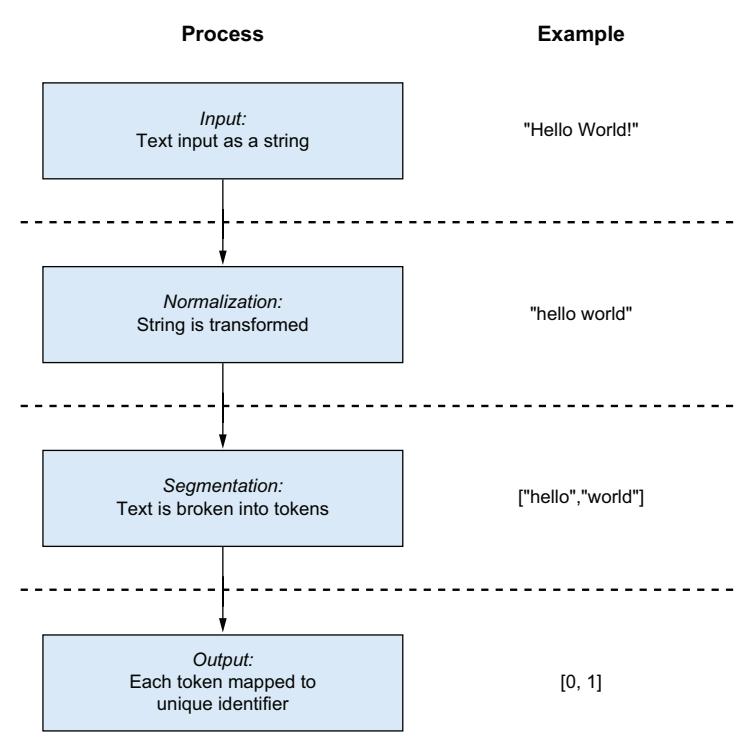
Figure 2.2 Generically, tokenization involves processing input to produce numeric identifiers for tokens.
The first and last parts of this process have little room for choice or different behavior. First, you need input to process; last, you need a numeric identifier for each token to store and retrieve the information you will associate with that token. The two middle steps, normalization and segmentation, are where you can choose what happens.
The last step of the tokenization process is where the vocabulary is built. The vocabulary of a model is the total number of unique tokens that are seen during training when we give the algorithm data to learn from. It almost always takes a large amount of data to build a rich vocabulary with many unique tokens.
Choosing the vocabulary for a model involves a series of trade-offs: the larger the vocabulary, the more information your model can process successfully. Consider a one-year-old child with a vocabulary of maybe a few dozen words. This child will not be a very effective communicator (but that’s okay; they have lots of time to learn). So a more extensive vocabulary not only helps the model understand more things, but it also makes the model larger. If you have a vocabulary that’s too large, you may make the model slower due to the number of computations required to use it, or the model may consume an excessive amount of memory or disk storage, which makes it more difficult to transfer or share to other machines—for example, when deploying it as a part of a software application.
You build the model’s vocabulary by processing the training data and identifying tokens. Each time you see a new token, you give it a unique identifier based on the number of unique tokens you’ve seen. This process is often as simple as storing a counter set to 0 and incrementing it every time a new token is found. Once the process is complete, you have a tokenizer that is effectively an encoder. The tokenizer can receive text as input and return a numeric encoding of that text that the LLM algorithms can use as its output.
2.2.2 Controlling vocabulary size in tokenization
GPT-NeoX, a publicly available LLM, takes about 10 GB to store its vocabulary on disk. That is a lot of data, already large enough to make many real-world use cases challenging from the perspective of data storage and computation. It is so large that storing it on a micro-SD card would be prohibitively slow, making use on a mobile phone or some game consoles a significant challenge. It is big enough that it can’t be streamed in real time and must be downloaded and loaded into the processor’s RAM to perform tokenization. However, a vocabulary must be sufficiently large to represent all words and subwords the model will encounter during training and use. Suppose a model encounters a word that is not in its vocabulary and cannot be represented by combining subwords in its vocabulary. In that case, the model cannot capture information about that piece of text. As a result, it is essential to weigh concerns about vocabulary size against the need for models to interpret a wide variety of content. In NLP, this is often called the out-of-vocabulary problem, when we encounter words we can’t represent using the tokens available to the model.
Vocabulary size is one factor contributing to an LLM’s size, so discussing methods and tradeoffs for controlling vocabulary size is vital. In this section, we will describe how changing the tokenization process’s behavior can influence vocabulary size and affect model capabilities and accuracy.
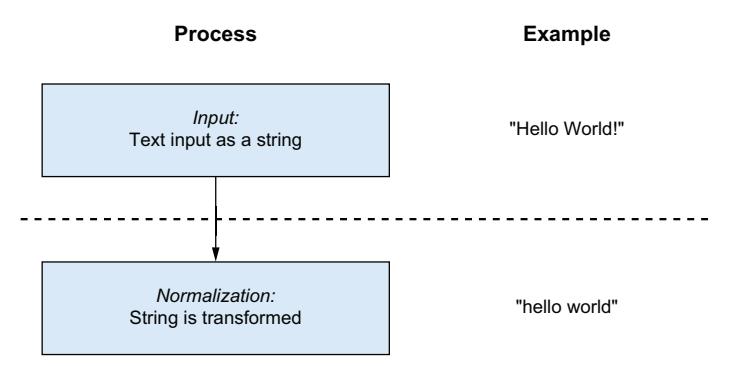
Figure 2.3 The normalization process commonly involves changing text to remove uppercase characters and punctuation.
In figure 2.3, we focus on the second transformation step, normalization, which converts the uppercase characters “H” and “W” to lowercase and removes punctuation. These common normalization steps originate from classical NLP pipelines and are still sometimes done in modern deep learning approaches today. They have the immediately desirable effect of reducing the size of the vocabulary. Instead of needing to represent “Hello” and “hello” as two separate tokens, they get mapped to one unique token. This mapping makes an enormous difference because every word that starts a sentence and gets capitalized would potentially duplicate a word in the vocabulary with a capitalized version. Such normalization can also help with various typos and misspellings.
For example, while writing this book, we typed LLMs, LLms, and llms, and made various other mixed-case typos. Converting each character to lowercase in each variation resolves all these typos into a single, simple form, so we get a smaller vocabulary and decrease ambiguity.
However, converting text to lowercase doesn’t always decrease ambiguity. Consider Bill and bill. In the first situation, capitalization is vital for understanding that Bill is probably someone’s name, and bill is more likely a unit of money (or one of the other definitions of “bill”). Capitalization is crucial not only for understanding the meaning of the text but also for understanding the errors in the text. Consider again all the various ways we miscapitalized LLMs in this book. A high-quality AI algorithm would be able to recognize that we made a typo and correct it! ChatGPT is capable of this and thus requires capitalization in the model. So there is an important tradeoff between vocabulary size and potential model accuracy to consider.
In classical NLP and even not-that-old deep learning models like BERT (a predecessor to the LLMs that power ChatGPT), the ability of an algorithm to recognize typos and fix them was extremely limited outside of solutions designed explicitly for that purpose. For this reason, much of the work that used to go into engineering a robust normalization step has been discarded for LLMs today. A more extensive vocabulary is desirable to produce more capable models that can learn to understand mistakes.
2.2.3 Tokenization in detail
The normalization and segmentation steps in the tokenization process largely determine the vocabulary size. In figure 2.4, we show one of the most straightforward strategies for tokenization. This strategy follows a simple rule: any time a space is seen in the text, split the larger string into those tokens. In the case of “hello world,” it is as easy as calling "hello world".split(" ") in Python. This is a reasonable approach to take; it is how we, as humans, read sentences. But it also adds some subtle complexity.
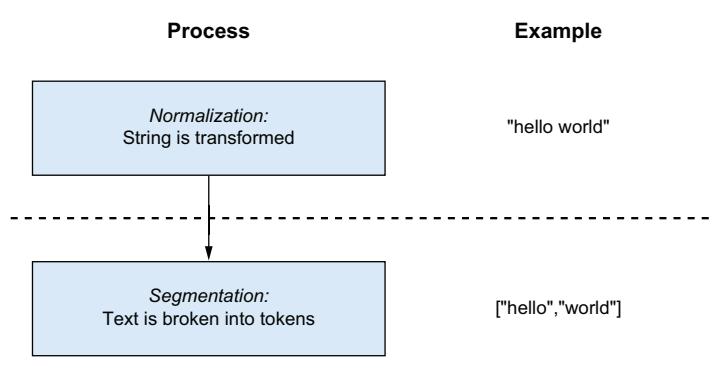
Figure 2.4 The segmentation process breaks normalized text into words or tokens so that each can be processed independently.
What happens when you have punctuation in your text? If we use our white space rule to convert the string "hello, world" into ["hello,", "world"], we run into a similar problem as we do with capitalization. We end up with two distinct tokens for the same concept: hello and hello,. The old-school approach often addressed this by removing and developing more complex rules for splitting strings into tokens. While this is a step in the right direction toward reducing vocabulary size, manually specifying tokenization rules does not address other concerns. For example, rulebased tokenization strategies are a significant struggle for languages like Chinese that do not use spaces to separate words.
IDENTIFYING SUBWORDS WITH BYTE-PAIR ENCODING
The general theme of LLMs is to do less feature engineering by hand and let algorithms do the heavy lifting instead. For this reason, an algorithm known as byte pair encoding (BPE) is typically used to break strings into tokens. Byte pair encoding is an algorithm for breaking words into common subword sequences of characters. BPE today is usually done with a custom segmenter and almost no normalization.
NOTE By experimentation, we see many ChatGPT-like products will remove some Unicode characters that do not print (Unicode is weird), but otherwise mostly take your text as-is. Most prior language models do use various flavors of normalization, and how to normalize text for LLMs better is, we think, a good and open question.
Since finding the most efficient set of subwords is a computationally expensive task, BPE uses a heuristic to take a shortcut. It starts by looking at individual letters as tokens and then finds pairs of adjacent letters that occur most frequently and combines them into subword tokens. The algorithm repeats this process many times, continuing with subword tokens, until some threshold is met and the vocabulary is “small enough.” For example, in the first pass, the BPE algorithm examines the frequency of the individual letters used in English and encounters the letters “i,” “n,” and “g” near each other frequently. In the first pass, BPE might observe that “n” and “g” occur together more frequently than “i” and “n,” so it will produce the tokens i and ng. In a subsequent pass, it may combine those tokens into ing based on the frequency of that combination of letters versus how often “ng” occurs with other letters or subwords. Once BPE has reached its stopping point, it will have identified individual words such as “eating” and “drinking” as frequently occurring combinations. It may also capture “ing” as a suffix so that other words ending with that subword can also be represented as tokens. When the algorithm is complete, we end up with tokens that capture complete words and others that capture subwords. This process is shown at a high level in figure 2.5.
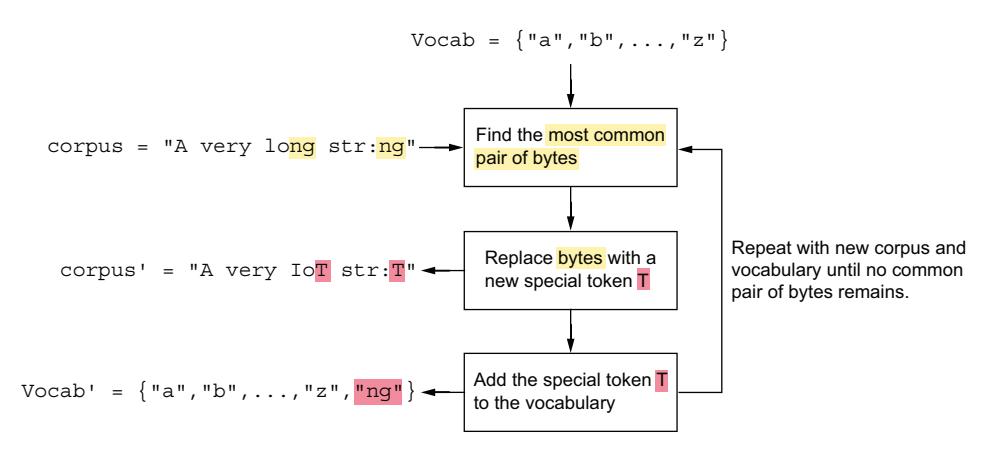
Figure 2.5 A simplified byte pair encoding algorithm for creating tokens: first, find the most frequent pair of characters “ng.” Next, replace all instances of “ng” with a placeholder token “T,” and add “ng” to the vocabulary. Repeat the process until no common byte pairs remain.
NOTE Running the BPE algorithm to create a vocabulary is surprisingly expensive because it must read the input data many times to calculate the most frequent combinations of letters. While LLMs are trained on over 500 million or even 1 billion pages of text, their tokenizers are usually created using a tiny subset of that data. Often, a tokenizer is trained using a much smaller collection of text the size of a novel.
The BPE process may seem odd at first, but you can think of it as a way of identifying common strings in a corpus. For example, BPE will almost always learn to represent New York as one token, which is useful since the state and city of New York are frequent occurrences in the text. Representing the whole concept as a single token makes it easier to use that kind of information. Indeed, most common words will become unique tokens, while rare words are hopefully captured as a combination of subwords. For example, loquacious will be tokenized by GPT-4 as lo, qu, and acious. This method is a success because “acious” is a Latin postfix for inclination/propensity, making it easier for the model to handle an unusual word correctly. It is also a failure case because the Latin prefix “loqu” got broken up into two tokens instead of one, making learning harder.
After BPE is used to make a vocabulary, model authors manually add additional tokens for various reasons, such as words that are important to a specific knowledge domain. As we will discuss in the next section, in some domains, having the correct tokens has a significant effect by capturing nuanced meaning. So often, the authors will make sure the necessary tokens are included. Model authors will also add special tokens that don’t directly represent word parts but provide auxiliary information to the model. Some common examples of this are the “unknown” token (typically represented as [UNK]), which is used if the tokenizer fails to process a symbol correctly, and the system token [SYSTM], which is used to distinguish between a model’s built-in prompt and user-entered data, as well as other kinds of stylistic markers. Multimodal models that accept text and image inputs use unique tokens to tell the model when the input stream switches between bytes that represent text data and bytes that represent image data.
Open AI decided to use BPE to encode text into tokens when they developed ChatGPT and have released their tokenizer as the open source package tiktoken (https://github.com/openai/tiktoken). Still, several other algorithms and implementations for automatically generating tokens are available, including the WordPiece and SentencePiece algorithms developed at Google [4]. Each of these have different tradeoffs. For example, WordPiece uses a different technique for counting the frequency of the candidate subwords when building the tokenizer’s vocabulary. One of the algorithms implemented in SentencePiece processes entire sentences, preserving white space when calculating tokens, which may improve output when building models that handle multiple languages. However, BPE is the most broadly used algorithm. For example, it is now used exclusively in Google’s recent LLMs.
Regardless of the algorithm chosen, the size of a tokenizer’s vocabulary is a critical model parameter determined by the data scientist or engineer in charge of training and augmenting the tokenizer. The following sections dive deep into some of the considerations on vocabulary size and other decisions made throughout the tokenizer development process.